Frequently Asked Questions
The Program
Q: What roles are available at pega6?
Currently, pega6 is focused on one role: the Project Engineer (also known as a Field Engineer).
Q: Will pega6 add more roles?
Yes, we plan to add dozens of white-collar construction & engineering roles. Ultimately, we’ll offer hundreds of white-collar roles across dozens of industries.
Q: Does pega6 focus on any senior roles?
No. We created pega6 to solve one problem: Universities don't prepare students for the workforce. So, pega6 is exclusively focused on building a new category of higher ed (the white-collar trade school) that is optimized for producing the job-ready entry-level graduates.
Q: How long is the program?
One year. 40-50 hours per week.
Q: Is the program virtual or in person?
Pega6 is a hybrid program. Meaning you will alternate days working in person and remotely with your teams on your projects.
Q: Where is the program located?
Kansas City.
Q: When does the founding cohort start?
Fall 2027. Join the waitlist, and we'll notify you as soon as exact dates are set.
Q: How much does pega6 cost?
One time $15,000 tuition. Students are responsible for their own living expenses during their year in Kansas City.
Q: Who is this for?
Graduating high school seniors who want to be engineers in the construction & engineering sector and build structures of consequence.
The Role
Q: What is a Project Engineer?
Also known as a Field Engineer, it is the entry-level role at a general contractor who keeps the plans, people, and work aligned. That means ensuring the work on the construction site matches the building plans, coordinating with sub-contractors so they know what to build and when, and keeping the project compliant and on schedule.
Q: Is that the same as a Project Engineer at a design consultancy?
No. At a design consultancy, "Project Engineer" is a mid-level role several years into someone’s career.
Q: Are students working on live construction projects?
No. Every project in the pega6 curriculum is a high-fidelity simulation designed to replicate the work you'd do at an actual general contractor. We’ve created our own proprietary regimen of professional-grade projects rather than have you work on a live project with a construction firm. We’ve designed our program like this for three critical reasons:
No skill gaps. There will always be key skills that you won't use when working on a given live project — leaving you with meaningful skill gaps. However, we have carefully designed the projects at pega6 to ensure that you will learn and use every important project engineering skill.
Failing safely. Failure is the best teacher, bar none. But if you miss a deadline or miscalculate a concrete pour on a real project, you could cost someone millions of dollars or even their lives. Missing things on pega6’s simulated projects is part of the journey, and you simply get coached up by our experienced project managers so you can do it right on the next build.
Incredible variety of experiences. With eight projects across commercial and mission-critical construction in twelve months, you receive a variety of experiences that even a full-time Project Engineer wouldn't receive in their first two to three years on the job at an actual construction firm.
The Outcomes
Q: Is there an employment guarantee?
Yes. We’re lining up guaranteed employment for every pega6 graduate right now, so each graduate will have a job offer from a general contractor upon graduation, or we’ll refund their entire tuition. Stay tuned!
Q: What’s the starting salary for a Project Engineer?
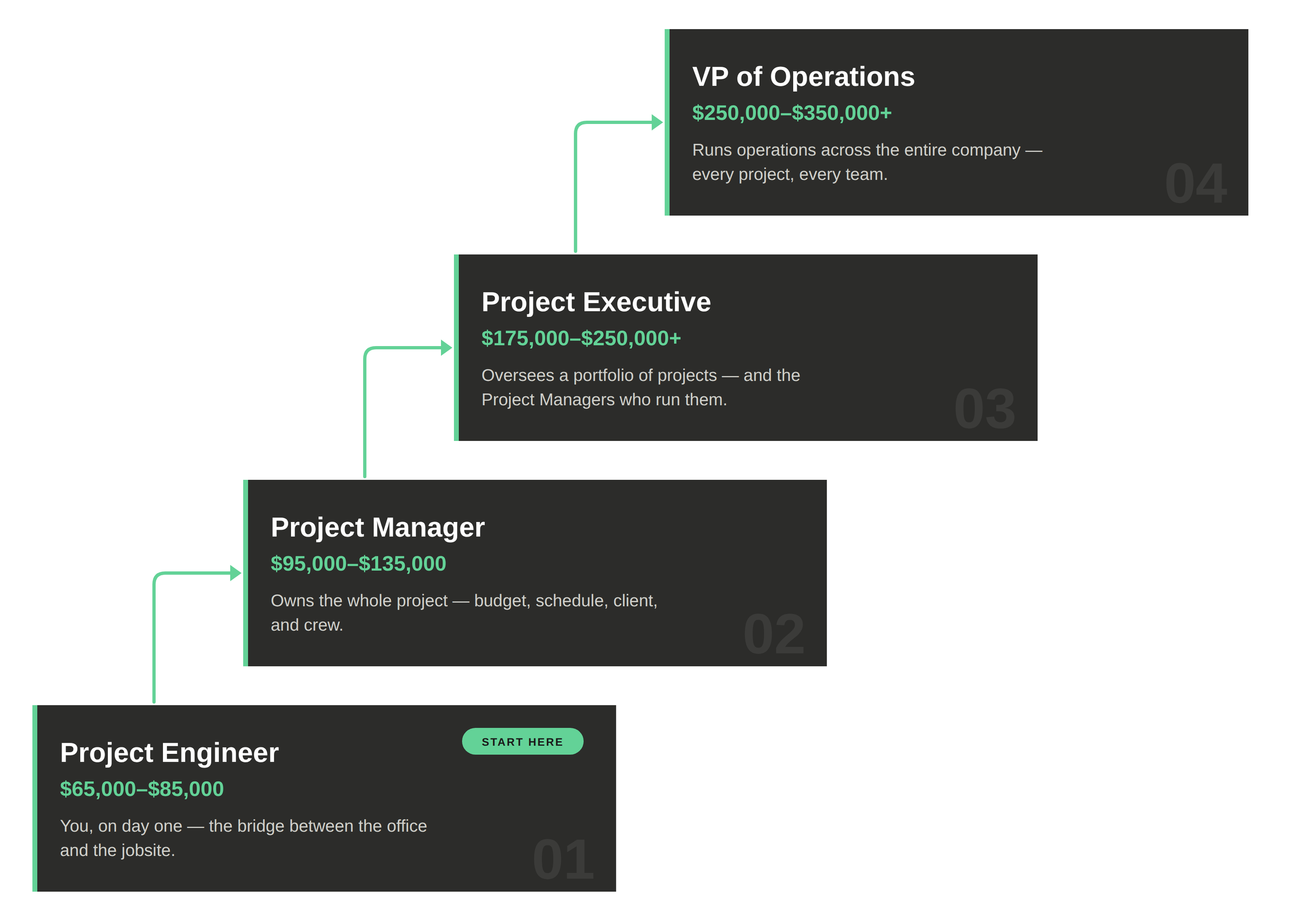
The national average is $65,000–$85,000, varying by region and firm. (As of August 23, 2026: Birmingham Group; Indeed; Salary.com; ZipRecruiter)
Q: Do students graduate as "AI-natives"?
Yes, and we mean something specific. AI is not a subject in this program; it's the medium. Every student uses it throughout every project and then confirms the AI’s output using the expertise and professional judgement they’re accumulating throughout the program. Pega6 students are masters of knowing how to use AI to maximize productivity because it’s naturally part of how they learned to work.
Q: What's the career path for a Project Engineer?