Project Engineers: Making sure the job gets done right.

What is a Project Engineer?

Also known as a Field Engineer or Engineer, a Project Engineer is the entry-level engineer at a construction & engineering firm who bridges the office and the jobsite. When a hospital, a school, a hotel, or a data center gets built, somebody has to keep the plans, the people, and the actual work lined up with each other. That's this role.

You're in the office when a decision is being made, in the field when the work is being done. It's a career for people who like solving real problems in real time and who want to watch something they worked on get built.

What is a pega6 Project Engineer?

Unlike college graduates, who don’t even begin learning how to be a Project Engineer until they start their first job, pega6 grads know exactly what they’re doing from day one.

And pega6 students graduate as AI-natives who not only possess the technical knowledge of experienced Project Engineers, but they’ve also mastered the AI tools that supercharge their productivity.

A typical day for a Project Engineer . . .

Reading drawings and specs

Every building starts as a set of plans. Project Engineers read them cover to cover so they know what's supposed to happen and can spot when something on-site doesn't match.

Keeping projects compliant and on-schedule

Proof that the materials showing up match what was designed (submittals), questions sent back to the designer when something isn't clear (RFIs), daily reports, change orders, inspector paperwork. It's the difference between a project finishing on time and one that stalls.

Coordinating with the people doing the work

Subcontractors, the specialists who pour the concrete, install the plumbing, wire the electric, need to know what to build and when. You're the person keeping them aligned with the plan and with each other.

Walking the jobsite

You spend real time on the actual construction site — checking that the work matches the drawings, taking photos, catching issues before they get expensive.

Your compensation and career path.
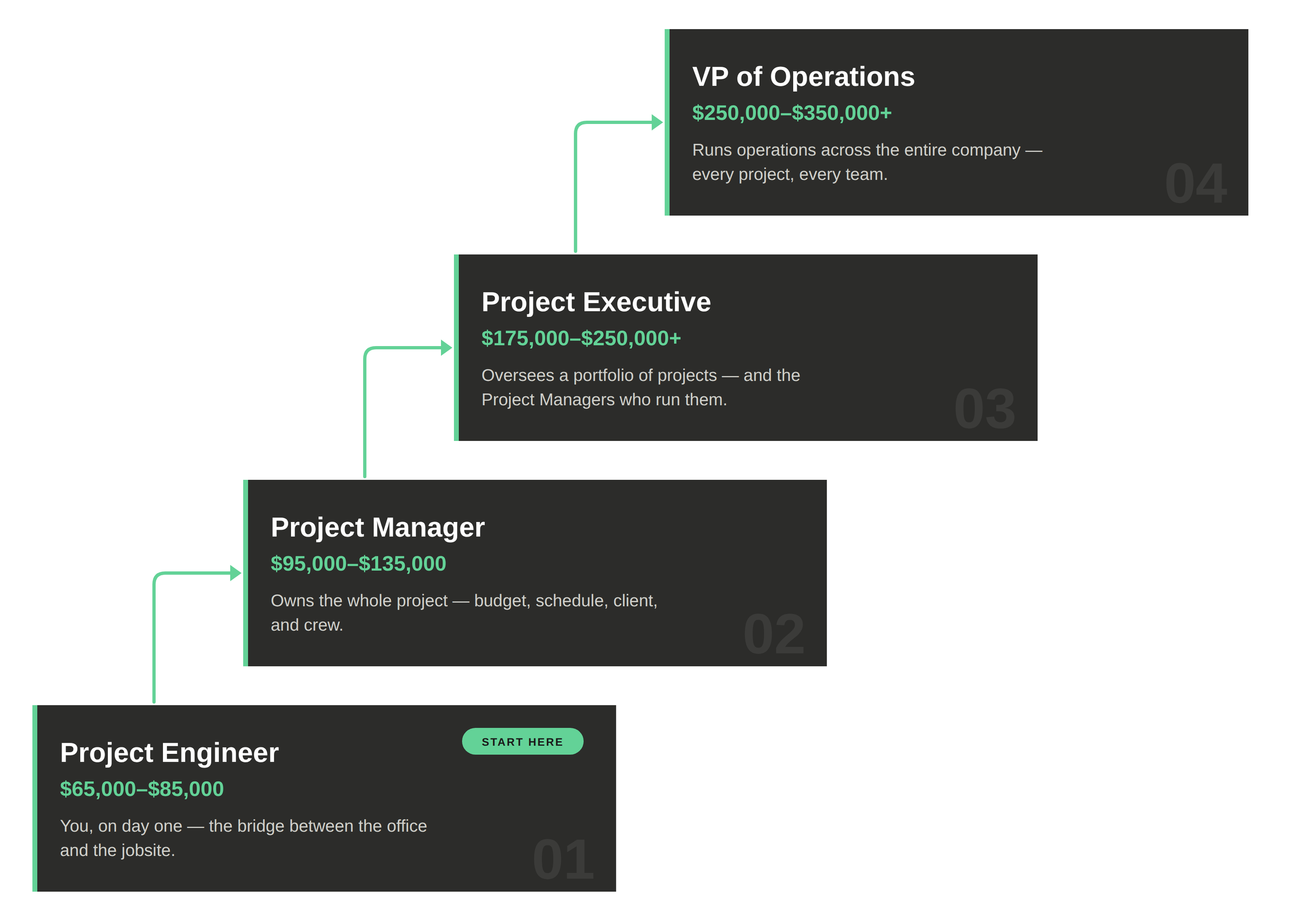
Starting salary for a Project Engineer at a general contractor is $65,000–$85,000 a year, varying by region and firm size.

That's the number you'd start at, at 19, with pega6 on your résumé. For comparison, a four-year civil engineering college grad gets paid . . . the same . . . except, three years later with $100,000 in student debt.

And that’s just the beginning. There’s a clear path of progression and significant salary increases as you advance in your career.

Note: Base salary figures sourced are national base-pay averages from PayScale, the U.S. Bureau of Labor Statistics, Salary.com, and The Birmingham Group's 2026 Construction Salary Guide.

A glimpse of the future . . .

The day you graduate from pega6, these are the skills, competencies, and experiences that you will possess.

And these are the skills, competencies, and experiences that all general contractors want in a Project Engineer.

pega6 Project Engineer — Cut Sheet
Manufactured by
pega6
White-Collar Trade Schools
Doc No. PE-001
Revision v0.3
Program 12 months
Project Engineer I
Model: AI-Native Project Engineer
Entry-level field / project engineering
Application: General Contractor · Commercial & Mission Critical
Performance Data
2,000+
Supervised project hours
8
Projects delivered
50
Skills at mastery level
38
Skills at proficiency level
Capabilities (what they can do)
✓Read a multi-discipline plan set and identify sheet-to-sheet conflicts before the field does
✓Produce a quantity takeoff, AI-assisted and manually verified, within 5% of the reviewed quantity
✓Draft an RFI the design engineer can answer without a follow-up question
✓Assemble and route a complete submittal package and keep the log current
✓Build a procurement log from the specs and schedule, then chase deliveries against it
✓Turn a day of field conditions (photos, readings, tickets) into same-day documentation a PM acts on without clarification
✓Run a subcontractor coordination meeting: agenda, minutes, action items, follow-through
✓Maintain a 3-week look-ahead and run a pull plan with the trades
✓Track self-perform crew hours against budget and flag a productivity problem before it compounds
✓Quantify, document, and communicate the impact of a mid-project scope change
✓Carry 3+ concurrent workfront assignments with no dropped deadline
✓Take redlines on any deliverable and return it corrected without repeating the noted errors
✓Identify when an AI output is wrong and correct it before it ships
Deliverables (what they can produce)
Daily field reportDaily
Field notes & photo documentationDaily
RFI (draft + log management)Weekly
Submittal package & logWeekly
Quantity takeoffWeekly
Layout verificationWeekly
Meeting minutes & action itemsWeekly
Look-ahead schedule (2-3 week)Weekly
Quality / inspection checklistWeekly
Procurement & delivery logWeekly
Labor productivity reportWeekly
Quantity tracking vs. estimateBiweekly
Change-order supportMonthly
Engineering memo / calc packageMonthly
Closeout package (punch, as-builts, O&M)Per phase
Competencies & Skills Schedule
Engineering Fundamentals5 skills
Surveying & measurement · Geotechnical basics · Soil mechanics · Statics & mechanics · Structural analysis basics
Civil & Site Literacy7 skills
Erosion & sediment control · Site grading · Site layout & geometry · Drainage & stormwater · Pavement & hardscape · Site utilities · Detention & water quality
Building Systems Literacy11 skills
Cast-in-place concrete · MEP coordination · Structural steel · Building envelope · Electrical & switchgear · Fire protection & life safety · Interior finishes · Mechanical & cooling systems · Mission-critical redundancy · Roofing & waterproofing · Vertical transportation
Construction & Field Engineering11 skills
Construction sequencing · Layout & control · Punch list & closeout · Quantity takeoffs · RFIs & field questions · Shop drawing review · Site inspection & QA/QC · As-builts & O&M turnover · Commissioning & startup · Construction safety · Materials testing
Self-Perform & Productivity6 skills
Crew sizing & manpower · Labor productivity tracking · Unit rates & production goals · Cost coding & labor hours · Self-perform carpentry ops · Self-perform concrete ops
Project Delivery10 skills
Lean & pull planning · Procurement & buyout · Site-report documentation · Subcontractor coordination · Cost estimating · Owner & client communication · Permitting & inspections · Project scheduling (CPM) · Scope & change management · Stakeholder negotiation
Practices8 skills
Field verification · Plan set reading · Quantity documentation · Redlines & markups · Code & standards · Model & CAD navigation · Specifications · Technical report writing
Soft Skills9 skills
Clarifying questions early · Coachability · Communication · Ownership & follow-through · Professionalism · Teamwork · Escalation judgment · Grit · Time management
AI Fluency3 skills
AI output verification · Agent orchestration · Agentic workflows
Tools & Software12 skills
Bluebeam Revu · Claude · Excel · Procore · AutoCAD · Civil 3D · MS Project & Primavera P6 · Navisworks · Revit · Autodesk Build / ACC · Point-cloud & reality capture · Power BI & dashboards
Bold = mastery · plain = proficiency · grey = familiarity
pega6 certifies this Project Engineer has been reviewed against all of these specifications and is optimized for entry-level field/project engineering work at your company.
APPROVED
pega6 · Reviewed to spec
Cohort 2027

Ready to become a Project Engineer?